
The Woodwork
Although the crossbar was a later addition, goal posts date from the
earliest days of the modern game - albeit in primitive form. Often little more
than long sticks, these goalposts also helped players to keep track of the
number of goals scored by each team - every time a goal was conceded a little
nick was put into the post, hence the phrase 'to score a goal'. Goal posts
nowadays take the form of an elliptical post although the traditional wooden
square posts can still be found at lower levels of the game and in Scotland. It
is a little known fact that though goal posts are almost invariably painted
white, there is no rule within the game about this. Theoretically, they could be
painted any colour you like (Tottenham Hotspur's posts were once painted blue and white, for example).
Crossbars became compulsory in 1882, having been experimented with as early as 1875 (Both Sheffield FC - England's oldest club - and Queen's Park, their Scottish counterparts have claimed responsibility for introducing them into the game). Before that, tape was stretched between the posts eight feet above the ground - as in the first FA Cup Final in 1872 - although when the first laws of the game were drawn up, there was no mention of a crossbar. As in rugby today, a goal could be scored at any height as long as the ball went between the sticks or posts.
The modern crossbar is curved to allow for the effect of gravity, which pulls the middle down when it is in position. The exact height of the crossbar is laid down in the rules of the game and is rigidly enforced, although there have been occasional lapses.
In 1989 Portsmouth were somewhat embarrassed when it was discovered that one of the crossbars at Fratton Park was an inch too low. Hearts, meanwhile, were shocked to discover that one of the crossbars at Spanish club Mallorca was lower than the other prior to a European Cup Winners Cup-tie in 1998.
In 1888, Swifts, a team based in Kensington, London, were disqualified from the FA Cup when opponents Crewe Alexandra lodged a complaint about one of the crossbars after their Cup tie had finished 2-2. They claimed that it was two inches lower than the one at the other end of the field and two inches below the height required by the rules. The FA upheld their complaint and Crewe went on to reach the semi-finals but the Football Association passed a rule that all protests about the gound, markings and goals must be made before kick-off and not after the final whistle.
On occasion, games have been disrupted by part of the woodwork breaking. In
the 1994 World Cup Finals the QuarterFinal tie between Mexico and Bulgaria came
to a halt when the Mexican goal collapsed under the weight of several players
falling into the net. In this instance a replacement goal enabled the game to
continue but in 1981 Chester had to abandon a League game when a goal collapsed
 after
goalkeeper Grenville Millington collided with the goalpost. Other breakages of
note include a seven-minute break in play during an FA Cup tie between
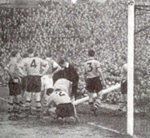
Wolverhampton Wanderers and Bournemouth in 1957 after Cherries striker Reg
Cutler became entangled in the netting (see picture), and a delay of over 90
minutes in Madrid after one of Real's goalposts collapsed during the pre-match
warm up before a European Champions League game.
after
goalkeeper Grenville Millington collided with the goalpost. Other breakages of
note include a seven-minute break in play during an FA Cup tie between
Wolverhampton Wanderers and Bournemouth in 1957 after Cherries striker Reg
Cutler became entangled in the netting (see picture), and a delay of over 90
minutes in Madrid after one of Real's goalposts collapsed during the pre-match
warm up before a European Champions League game.
But the first recorded stoppage due to the woodwork breaking came during the 1896-97 season when William "Fatty" Foulke brought a First Division game to a halt by snapping the crossbar after he decided to hang off it to relieve his boredom...
Of course, no mention of breaking woodwork would be complete without another Chic Brodie annecdote. "The One-Man Natural Disaster" managed to destroy his entire goalmouth while playing for Brentford after swinging from the crossbar in an attempt to put a dangerous looking cross over the bar in a game against Lincoln City...
When Swansea Town entered into the Southern League in 1911 it was such a rush job to bring the Vetch Field up to scratch that workmen were still completing the erection of the goalposts as the home side and their opponents, Cardiff City, took to the field for their first game.
The Netting
Goal nets were the invention of J. A. Brodie, who took out a patent for his
invention in 1890. The first official use of nets date from 1891 when they were
used at Crosby Cricket ground near Liverpool, then home to a section of Old Etonians playing for a club called Liverpool Ramblers AFC, and at Nottingham Forest's Town
Ground. They were first used in an FA Cup Final in 1892 but it was some time
before they were used regularly in International matches, which led to the odd
disputed goal.
When Jack Barton scored the ninth goal for England against Ireland in Belfast in 1890, the Irish players claimed the ball had gone over the bar and when Willie Gibson scored a very late equaliser for Ireland in 1894, England's goalkeeper Joe Reader claimed the ball went past the post. It was the first time Ireland avoided defeat against England. Finally, when Billy Bassett put England ahead against Wales in 1889, the Welsh defenders claimed the ball had gone past the post.
But even when nets became widespread there were still disputes. The tautness of the mesh of those early nets was a particular problem, as the ball would often rebound. In the 1908-09 season West Bromwich Albion missed out on promotion by a fraction of a point after a referee disallowed a goal, thinking that the ball had hit the crossbar, and Aston Villa were relegated to the Third Division after a similar incident in 1970. Crystal Palace's Clive Allen had a perfectly good goal wiped-out against Coventry City in 1980 when his free-kick rebounded off the stanchion at the back of the net while Millwall's Paul Ifill saw a goal ruled out in 1999 during a game at Colchester United's Layer Road ground after the officials failed to realise the ball had hit the back of the netting and bounced out again.
The deepest goal nets in Europe are thought to be those at La Romareda Stadium in Zaragoza, where they extend a full four metres back from the goal line.
The first personalised nets were made by the inmates of Durham Prison, who make around 750 goal nets a year. These are sold to a number of football clubs, including Leeds United and Sunderland, and cost up to £200 a time.